

30 Minutes to Make a Deal: Are You Ready for the Rights Room?
This article first appeared on Mercy Kirui’s Substack, Mercy the Book Agent, and is shared on LiteraryWorld with her kind permission.
30 Minutes to Make a Deal: Are You Ready for the Rights Room?
What authors, publishers and literary agents should bring to a rights meeting, and what every rights catalogue must include
By Mercy Kirui · Publisher, Literary Agent & Rights Consultant

When people hear “rights meeting”, they often picture something glamorous: a beautiful book fair hall, good coffee, interesting conversations and perhaps a contract signed over lunch.
The reality? A rights meeting usually lasts about 30 minutes. Sometimes less! And in that half hour, the person sitting across from you wants to know three things: What is this book? Why is the book important? Which rights are available?
If you cannot answer those questions quickly, you may lose their interest before the coffee gets cold.
So, what should you bring into the rights trading room? Let’s get practical.
First, who sells rights to whom?
Before we get to the checklist, let’s quickly look at how international rights trading works. This surprises many authors.
In many international markets, publishers buy rights from other publishers and literary agents rather than approaching authors directly. Many established publishers, particularly in markets such as the US and UK, do not accept unsolicited submissions.
When a publisher in Germany or Korea wants to translate a book, for instance, they look for the person or organisation controlling those translation rights. This is usually the original publisher or the author’s literary agent.
So, if you’re an author hoping to walk up to a foreign publisher and pitch your book directly, it can be challenging. Not impossible, but challenging. And that’s one of the reasons literary agents exist.
(If you missed Mercy’s earlier Rights Desk article, So, what exactly does a literary agent do?, read it here.)
Now, let’s get packing!
As an author
Your job is to know your book and, more importantly, know which rights you still own.
- Your publishing contract. Read it again. Which rights did you grant your publisher? Translation? Audio? Film? Which territories? Remember, you cannot sell what you have already signed away.
- A one-paragraph pitch. What is your book about, and why should a reader in another country care?
- A short author bio and a good photograph. Make it easy for someone to introduce you and your work.
- Proof of interest. Sales figures, awards, shortlists, reviews and festival invitations. These help a potential buyer see the book’s appeal.
- A sample in English (or another widely read language). Foreign editors may not read the original language, so a sample translation of a chapter or two can open doors.
- An agent or publisher handling your rights. If you don’t have one yet, finding the right representation is a good place to start.
As a publisher
You are often the rights holder, which means buyers may come looking for you. Be ready!
- A clear record of the rights you control. Check your author contracts before every book fair. Don’t assume you own everything.
- A rights catalogue. More on this shortly.
- Sample translations for your strongest titles.
- Sales, awards and review information for each book.
- A dedicated rights contact. Someone who responds to emails and follows up. (Yes, I had to say it! 😃)
- A company profile. Who are you, what do you publish and which markets do you operate in?
- An acquisition wishlist. Rights trading is a two-way street. Know what kinds of books and content you are looking to acquire, too.
As a literary agent
You are the bridge between authors, publishers and potential buyers. You need to know both sides of the business.
- Your representation agreements. Be clear about which rights and territories you are authorised to sell for each author or publisher.
- An updated rights catalogue. Review it before every fair.
- A submissions tracker. Who received which book, and when? Follow-up is half the job.
- Market knowledge. Know which publishers in which countries publish what. Don’t pitch a poetry collection to a publisher who only publishes cookbooks!
- Co-agents or sub-agents. Build relationships with agents who can help you reach markets you cannot access directly.
- Meeting notes and follow-up emails. Send those emails within a week of the fair, while people still remember your conversation.
The heart of it all: your rights catalogue
Almost everything on these checklists comes back to one important document: the rights catalogue, also known as a rights guide.
I often say that your catalogue is your passport in the rights business. Without it, you are not going very far!
I am quite digital, but I still prefer carrying a physical catalogue to meetings. There is something about placing a printed copy on the table, flipping through the pages together and leaving a copy behind. Of course, I also have a PDF ready to share after the meeting. We must embrace both worlds!
A good rights catalogue should be short, clear and easy to scan. For every title, include:
- Cover image
- Title and author
- Genre and age group: Adult fiction, non-fiction, poetry, children’s or YA.
- Format and length: Number of pages or word count, and whether the book is illustrated.
- Publication date and original publisher
- A short pitch: Two or three sentences that make someone want to read more.
- A short author bio
- Sales, awards and reviews: One or two strong review quotes are enough.
- Rights available: For example, “World translation rights available, except French.” This is arguably the most important line on the page.
- Rights already sold: Which languages and territories, and to which publishers? This helps demonstrate the book’s international potential.
- Available material: Full English manuscript, sample translation, synopsis or other relevant material.
- Rights contact details: Make it clear who handles enquiries (especially for publishers).
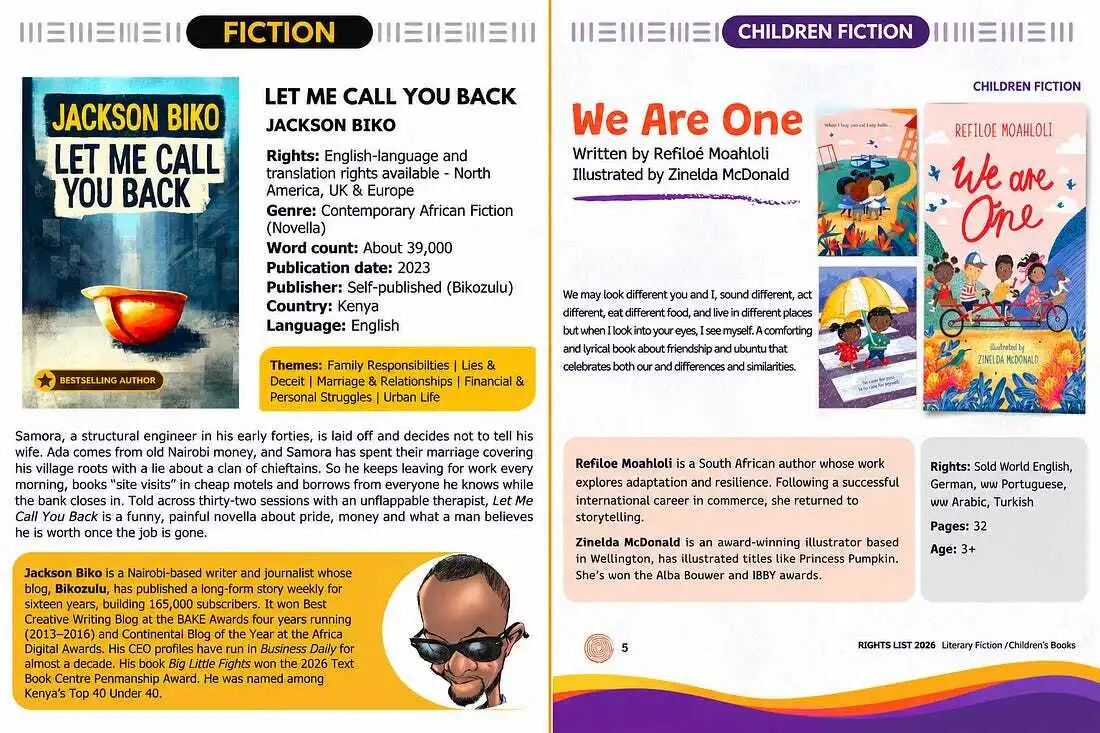
A page from my adult and children & YA rights catalogues
The most common mistake I see? Beautiful rights catalogues with absolutely no rights information!
Lovely covers, attractive blurbs and impressive author biographies, but not a single word about which rights are actually available.
A potential buyer should not have to email you just to establish whether they can make an offer. Make that information easy to find.
A few more tips
- Keep it current. If you sold rights last month, update the catalogue before your next fair.
- Keep it focused. Bring your strongest titles, not necessarily your entire backlist. Quality over quantity.
- Have a PDF ready. You should be able to email it immediately after a meeting. Many deals begin with that follow-up email.
- Be honest. If rights are under offer or already sold, say so. Transparency builds trust.
Looking for African books to translate?
Here’s a little secret: this is exactly what I do every day!
Through Tai AfroPress, I represent African authors writing adult fiction, non-fiction and poetry. Through the African Literary Agency, I represent children’s and young adult titles.
Explore our latest rights catalogues
Looking for your next African bestseller, a compelling children’s story or a fresh voice for your publishing list? We’d love you to explore the titles we represent. Browse and download our latest rights catalogues:
- Tai AfroPress Rights Catalogue: adult fiction, non-fiction and poetry.
- African Literary Agency Children & YA Rights Catalogue: African children’s and young adult literature.

If a title catches your eye, we’d be delighted to hear from you. Get in touch to request manuscripts, discuss available rights or explore a possible publishing partnership.
And if you’re attending a book fair where I’ll be exhibiting, let’s arrange a meeting. Early, please! 😉
A final word
The rights trading room can feel intimidating, especially the first time. I know it did for me. I remember walking into those rooms feeling like a lost sheep in the village! 😂
But looking professional isn’t necessarily about having the biggest stand, the fanciest business cards or years of experience. A lot of it comes down to preparation.
Know your rights. Carry your catalogue. Follow up.
And if you walk out of a 30-minute meeting with a business card and a “Please send me the manuscript”, congratulations. You’ve had a good day!
Do you have a question about preparing a rights catalogue, or would you like me to take a look at yours? Leave a comment below. Your question might just inspire the next Rights Desk.
Until next time, keep reading, keep writing and keep trading rights!
With great appreciation,
Mercy Kirui
Publisher, Literary Agent & Rights Consultant
Tai AfroPress | Mercy the Book Agent
Enjoyed this? Read more from Mercy on her Substack, and join the conversation with authors, publishers, and agents in the LiteraryWorld community: literaryworld.com/signup