

Beyond the Book Cover: Conversations That Challenge Prejudice
In a world that is quick to judge and increasingly unempathetic, the Living Library asks its users to slow down, listen and engage.
LiteraryWorld Interview | 5 Minutes
At the Living Library, stories are not found in books on shelves. Instead, the ‘books’ are alive and are sitting opposite, and the stories are their lived experiences. These people may be refugees, reformed drug addicts, transgender individuals, or others whose stories are often misunderstood, and they may have experienced hardship, discrimination and prejudice. Visitors are invited to meet, listen, ask questions, and engage in open conversations. The outcomes can be surprising, and the stories incredible and beyond our imagination—as the saying goes: “Truth is stranger than fiction.”
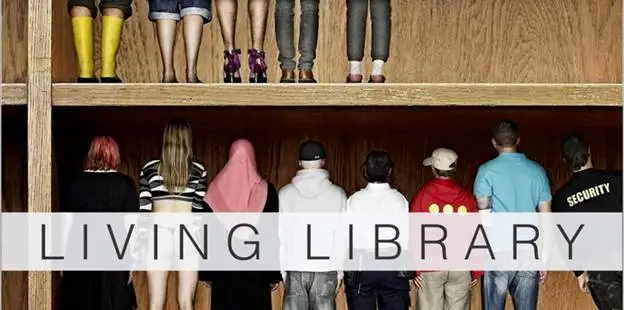
The purpose of the Living Library is simple yet powerful: to reduce prejudice through meaningful, one-on-one conversations. By encouraging dialogue, it aims to deepen understanding, increase tolerance, build empathy, and challenge stereotypes and taboos.
The impact of each encounter depends largely on the quality of the conversation and the motivation of the visitor. But let’s face it these kinds of human connections and conversations are needed now, more than ever.
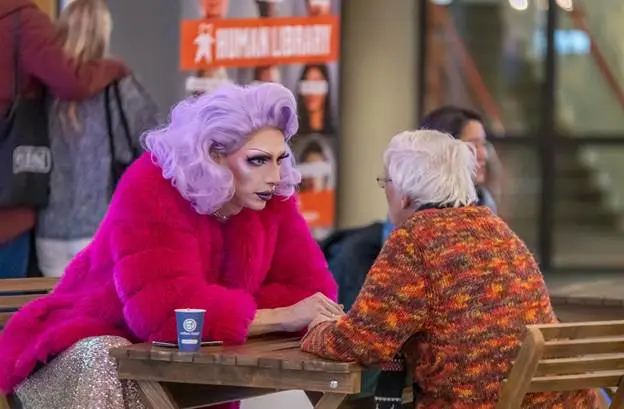
So, how does it work?
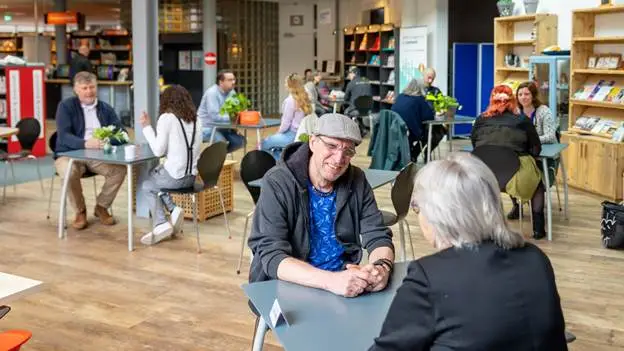
Visitors, known as ‘readers’, choose a ‘book title’ from a blackboard, like a catalogue. These titles might represent someone who has spent time in prison, experienced homelessness, recovered from drug addiction, or fled their home country as a refugee. The reader then sits down with their chosen living ‘book’ for an in-depth, one-on-one conversation lasting around 20 minutes.
Readers are free to ask any questions they wish, but the living book is never obliged to answer anything they are not comfortable with and can decline a question at any time. All conversations are monitored by a support team, which pays close attention to body language and signs of discomfort. When a conversation comes to an end, the reader returns the book and, if they choose, may then select another.
Inspired by the power of this initiative, I reached out to the founder of the Living Library, Martijn Bergsma, to learn more.
The very first Living Library took place in the year 2000 at the Roskilde Festival near Copenhagen, Denmark. Martijn first encountered the concept at an event in Turkey and, inspired by what he experienced there, went on to bring the Living Library to the Netherlands.
Today, the Living Library operates in more than 80 countries worldwide and is supported by countless dedicated volunteers and organizers.
Libraries interested in participating are encouraged to reach out directly to Martijn Bergsma and his team, who offer hands-on training and ongoing support. Additionally, if budgets allow, Martijn is willing to travel internationally to provide in-person guidance.